Saturday, July 31, 2021

Kevin Drum: ‘The Real Source of America’s Rising Rage’


Americans sure are angry these days. Everyone says so, so it must be true.

But who or what are we angry at? Pandemic stresses aside, I’d bet you’re not especially angry at your family. Or your friends. Or your priest or your plumber or your postal carrier. Or even your boss.

Unless, of course, the conversation turns to politics. That’s when we start shouting at each other. We are way, way angrier about politics than we used to be, something confirmed by both common experience and formal research.

When did this all start? Here are a few data points to consider. From 1994 to 2000, according to the Pew Research Center, only 16 percent of Democrats held a “very unfavorable” view of Republicans, but then these feelings started to climb. Between 2000 and 2014 it rose to 38 percent and by 2021 it was about 52 percent. And the same is true in reverse for Republicans: The share who intensely dislike Democrats went from 17 percent to 43 percent to about 52 percent….

What’s the reason for this? There’s no shortage of speculation. Political scientists talk about the fragility of presidential systems. Sociologists explicate the culture wars. Historians note the widening divide between the parties after white Southerners abandoned the Democratic Party following the civil rights era. Reporters will regale you with stories about the impact of Rush Limbaugh and Newt Gingrich.

There’s truth in all of these, but even taken together they are unlikely to explain the underlying problem.


Wednesday, July 14, 2021

David A. Graham: ‘Biden Is Speaking to an America That Doesn’t Exist’

 From The Atlantic:

Joe Biden is not known as a fiery orator, but the president was riled up yesterday [Tuesday, July 13, 2021].


Biden spoke in Philadelphia about voting rights, calling a current round of state laws and bills, plus rhetoric emanating from Donald Trump and others, “the most significant test of our democracy since the Civil War.” The president defended the 2020 election, celebrating the record voter turnout, praising election officials who made sure voting was smooth, and rebutting attacks lodged by Trump and his aides, who have baselessly claimed that the election was stolen or marred by fraud. “No other election has ever been held under such scrutiny, such high standards,” Biden said. “The big lie is just that: a big lie.”


But the president’s main focus was the next election, which he warned was gravely threatened. “I’m not saying this to alarm you,” he said. “I’m saying this because you should be alarmed.” He added, “We have to prepare now.”


The question is, who is we?


Biden’s speech assumes a unified American people who support democratic norms, and it assumes that once they understand the threat posed to those norms, they’ll be willing and able to fend it off. That nation is a chimera. Many Americans support these attacks on democracy, and those who don’t, face a system stacked against them.


Read the full story.

Sunday, July 4, 2021

Dan Balz: ‘Democrats have no clear strategy to counter voting restrictions’


From the Washington Post:


The 1965 Voting Rights Act has long stood as a symbol of the progress America has made in the struggle for civil rights and as a guardian of the right of all citizens to vote. Today, with two main provisions stripped of their power by the Supreme Court, the law has become a symbol of the weakening of resistance to the states’ efforts to restrict rather than expand and protect those rights.


In two decisions over eight years, the high court has taken away much of the law’s power, first in 2013 by gutting Section 5, which required states with a history of discrimination to seek clearance from the Justice Department before making any changes in election procedures, and on Thursday [July 1, 2021] by limiting the potential for successfully challenging voting changes after they have been enacted under Section 2.


The decision on Thursday involved two provisions in an Arizona law, one that called for discarding ballots cast at the wrong precinct, the other prohibiting what is known as “ballot harvesting,” a controversial practice in which partisans or activists collect absentee or mail ballots and deliver them to polling places. In allowing those provisions to stand, the court did nothing surprising. Many court watchers expected that to happen.


Read the full article.

Saturday, June 12, 2021

Happy Pride Month — and Please Don’t Add Any More Colors to the Rainbow Flag


Happy LGBT+ Pride Month to everyone who is observing!  The LGBT+ community has spent so much time forced into the shadows — I’m talking about decades and centuries — that I think it’s marvelous its members can now live openly and honestly without the awful stigma and disparagement once attached, at least in most of the Western world.  And I hope that all hate crimes against them will soon be completely and utterly relegated to the past.

As anyone who knows me can attest, I’ve spent a lot of time advocating for the greater inclusion of people of color (POC) in the media, and I’m a big fan of anything that can help raise their profile and those of other marginalized communities.  However, I’ve never grown to like adding colors to the now-familiar rainbow Pride Flag, with the six alternating primary and secondary colors.  While I think it’s important to recognize the contributions of further marginalized groups within the already marginalized LGBT+ community, I don’t think that adding extra colors to the Pride Flag is the way to go.  Why?  Because, very simply, it would mean — or be interpreted to mean — that LGBT+ people of color, and the others represented by the additional colors, were never a part of the original rainbow flag to begin with, that the rainbow flag never represented them.  Additional colors would mark the six-hued rainbow Pride Flag as exclusionary.

Still, I’ve kept my opinion on this matter to myself largely because (1) I’m not a part of the LGBT+ community and (2) an “official” Pride Flag has never been declared (and I understand that no one is in authority within the community to make any such declaration, which is as it should be).  I always figured that the LGBT+ community would resolved this issue on their own.

So, I was pleased to come across the above video by the YouTube user Shaaba, a member of the LGBT+ community and POC who also doesn’t believe that any additional colors should be attached to the six-striped rainbow flag.  She also discusses issues within the LGBT+ community which I, as an outsider, wouldn’t be able to articulate.  I’m glad that she agrees with me.  I hope that the other Ls, Gs, Bs, Ts, and the additional letters that make up the community will listen to what she says.

Wednesday, June 2, 2021

Greg Sargent: ‘A frantic warning from 100 leading experts: Our democracy is in grave danger’


 From the Washington Post:

Democrats can’t say they weren’t warned.

With yet another GOP effort to restrict voting underway in Texas, President Biden is now calling on Congress to act in the face of the Republican “assault on democracy.” Importantly, Biden cast that attack as aimed at “Black and Brown Americans,” meriting federal legislation in response.

That is a welcome escalation. But it remains unclear whether 50 Senate Democrats will ever prove willing to reform or end the filibuster, and more to the point, whether Biden will put real muscle behind that cause. If not, such protections will never, ever pass.

Now, in a striking intervention, more than 100 scholars of democracy have signed a new public statement of principles that seeks to make the stakes unambiguously, jarringly clear: On the line is nothing less than the future of our democracy itself.

“Our entire democracy is now at risk,” the scholars write in the statement, which I obtained before its release. “History will judge what we do at this moment.”

And these scholars underscore the crucial point: Our democracy’s long-term viability might depend on whether Democrats reform or kill the filibuster to pass sweeping voting rights protections.


Read the full article.

Wednesday, May 26, 2021

Andrew Prokop: ‘Any Bipartisan January 6 Commission Is Probably Doomed’


From Vox:

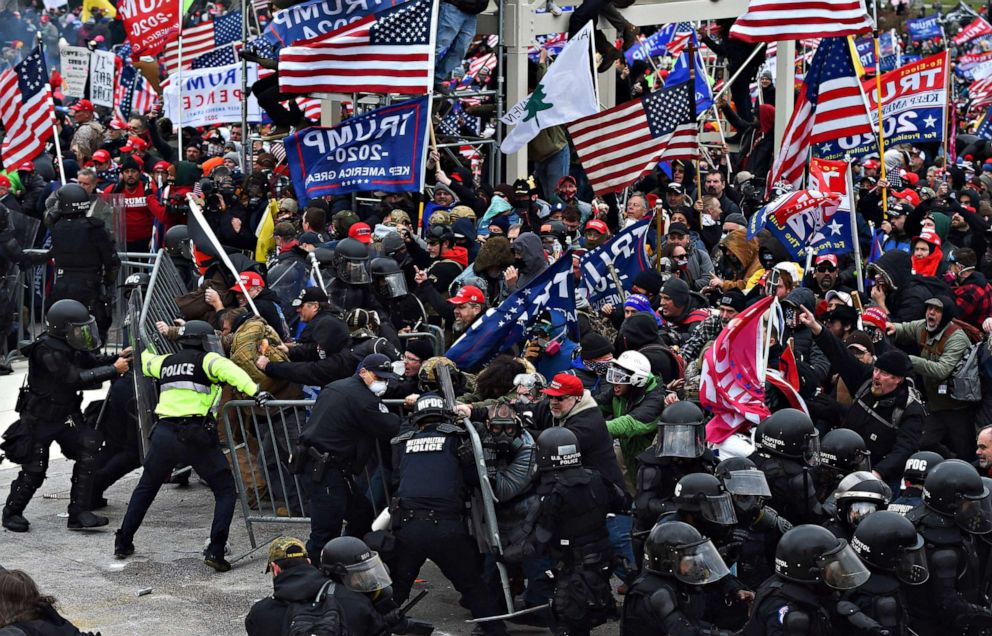
Days after the chaotic storming of the Capitol on January 6, some Republican members of Congress had an idea.

What the country needed, Reps. John Katko (R-NY), Rodney Davis (R-IL), and others decided, was a bipartisan commission, akin to the one established after 9/11, to sort through the facts and determine just how such a terrible breach of government security happened.

Now, though, the chances for such a commission are imperiled. A bill to establish it passed the House last Wednesday [May 19, 2021] with support from every Democrat and 35 Republicans. But most others in the GOP, including party leaders, have come out strongly against the bill, with the party’s senators planning a filibuster.

Republicans have evidently calculated that such a commission’s findings would likely hurt their party’s electoral prospects. Some even admit this: “Anything that gets us rehashing the 2020 election, I think, is a day lost on being able to draw contrast between us and the Democrats’ very radical left-wing agenda,” Senate Minority Whip John Thune told reporters last week.

But even if a deal does somehow come together, there are real reasons to doubt whether such a commission would achieve anything substantial.


Read the full article.