Showing posts with label Yasujiro Ozu. Show all posts

Wednesday, January 21, 2015

Second Thoughts on Ozu’s ‘Late Spring’


If anyone follows my blog (stop laughing), they would know that unlike many other cinephiles, I’m not a big fan of Japanese director Yasujirô Ozu: his films strike me as disagreeably reactionary, implicitly yearning for a “return” to a Japanese society based on patriarchy and filial piety.  However, I still watch his films to take in their unusual cinematic “grammar” — close-to-the-ground camera angles, characters speaking almost straight into the lens, abrupt cuts, unpeopled transition shots — and how it might change my positioning as a viewer.  I also remain intrigued by the sense of the transcendental or ethereal in his black & white films, a sense harder to detect, as I said before, in his color movies. 

I started watching Ozu’s films again while reading the book Transcendental Style in Film: Ozu, Bresson, Dreyer by Paul Schrader.  The book discusses how Ozu (in Japan), Robert Bresson (in France), and Carl Theodor Dreyer (primarily in Denmark) use a form of storytelling and imagery that suggest a realm or state of mind where there are no distinctions between humanity and nature: the Transcendent.  I won’t go into all of Schrader’s book here, because my focus is on Ozu, but its argument, in looking at the Japanese director’s films in relation to a concept of something seen to stand outside culture — the Transcendent — also risks naturalizing his conservative way of looking at the world. 
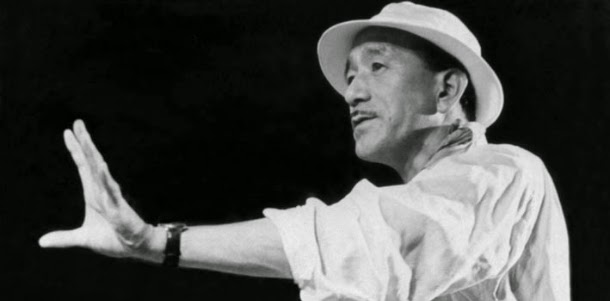
 
Yasujirô Ozu (1903-1963)

Indeed, the references to seasons and times of the day or year in so many of the Japanese director’s (English) titles — Late Spring (1949), Early Summer (1951), Early Spring (1956), Tokyo Twilight (1957), Equinox Flower (1958), Good Morning (1959), Late Autumn (1960), The End of Summer (1961), and An Autumn Afternoon (1962) — not only sound almost comically repetitive, but by linking his characters to the inevitable passage of time, Ozu seems to imply that the rightness and desirability of traditional Japanese culture are equally inevitable. 

Recently, I watched, for the first time, Late Spring (晩春, 1949), the first of Ozu’s family dramas (shomingeki) to have a season/time-based title, and my first impression of the film was that the narrative was in the same conservative mold as the director-screenwriter’s other films: Noriko (Setsuko Hara), a single woman in contemporary Japan, is recalcitrant to the idea of getting married, which her extended family pressures her to do, but she finally and reluctantly gives in after her widower father (Chishu Ryu) lies to her, saying that he plans to get married (again) himself.  Furthermore, the father’s speeches to his daughter on the benefits of marriage sound like didactic lectures straight out of an after-school special.  So, Noriko, whose single status calls the patriarchal social order into question, capitulates to an arranged marriage after constant badgering and being told a falsehood, consequently assuming her designated role in society.  And to me, the film seems to portray her capitulation in a positive light.  Not my kind of movie. 
 
Setsuko Hara as Noriko in ‘Late Spring’

Noriko and her father live alone together in the same house, with her performing the domestic role usually undertaken by a wife, such as picking up her father’s clothes as he drops them on the floor while changing into his yukata.   Noriko is satisfied with her role in the house, and when asked why she doesn’t get married, she says that her father would be “lost” without her.  When I heard this line of dialogue, I said to myself, “That doesn’t sound like a reason; that sounds like an excuse.”  That told me Noriko’s character hadn’t really been developed.  Also, Noriko’s Western-marked and sometimes obnoxious friend Aya (Yumeiji Tsukioka) married for love but later got divorced, which seemed to me like a plug for traditional arranged marriages. 
 
Chishu Ryu as Noriko’s father (wearing his yukata)

I watched Late Spring on a DVD put out by the Criterion Collection, a company whose meticulous attention to picture quality and supplemental materials of canonized classics makes it a cinephile’s best friend.  One of the supplemental materials on the disc was a commentary track by Richard Peña, an associate professor in film studies at Columbia University.  After listening to his remarks on the commentary track, I began to reconsider my first impression of the film.

To begin with, I didn’t take into account that Late Spring is contemporaneously set in the immediate aftermath of World War II (four years afterwards).  The fact that Noriko has assumed the role of the mother within her father’s house (in which the two live alone) only struck me as an example of filial piety.  A single woman past the ideal marital age (Noriko is 27) taking on a wife’s capacity in her father’s house (outside the bedroom, of course) would have struck a contemporary Japanese audience, according to Peña, as an odd arrangement.  (In recent decades, the ideal age for a Japanese woman to get married has been no later than 25, so young Japanese women of marriageable age are sometimes snidely called “Christmas cakes”: after the 25th [of December/birthday], “no one wants them,” or so the thinking goes.) 

This arrangement also (to more alert viewers) calls attention to the absence of both the mother and any male siblings, which, given the context of 1949, might have led Japanese viewers to infer that they died, directly or indirectly, because of the war.  And the absence of a larger family structure makes Noriko’s reason for not wanting to leave her father’s home more credible.  Noriko’s servitude — at least to her father — is not as positively portrayed as I first thought. 

And then there is Ozu’s singular cinematic style: the camera angles of most shots imitating the POV of someone seated on a tatami, full-frontal (as opposed to angled) close-ups of the characters, shots without any people in them, somewhat disorienting transition shots, etc.  This unusual approach to filmmaking is the reason why so many cineastes (myself included) keep returning to Ozu, and his champions say that this approach encourages the viewer not to take
the on-screen proceedings at face value.  After all, if Ozu wanted to make a film merely propagandizing Noriko’s capitulation to marriage, wouldn’t he want to use a film style as “invisible” to the audience as possible?

Noriko and her father at a Noh play
I’m very aware of Ozu’s critical view of the Western influence on Japanese culture, and how it compares unfavorably to his seemingly more positive view of traditional Japanese culture.  Late Spring early on associates the father with the accoutrements of traditional Japan: often clad in a yukata, often seated at a chabudai, enjoying a Noh play, etc.  By contrast, even though we first see her at a traditional tea ceremony and dressed in a kimono (albeit, as Peña points out, clutching a Western purse rather than its traditional Japanese equivalent), Noriko is thereafter associated with Western things: she almost exclusively wears dresses, and her room has occidental décor.

In the scene where the aunt (Haruko Sugimura) insistently has her first serious conversation with Noriko about the younger woman’s prospects for marriage, and the aunt refuses to let Noriko laugh off the idea (as she had previously), both start out seated at a chabudai.  When the conversation turns serious, a stubborn Noriko gets up from the chabudai and petulantly plops herself down on a Western-style chair. Because of these character markers, I get the idea that Noriko’s recalcitrant attitude towards marriage is a Western influence.  (Japan was governed at the time of Late Spring by the allied occupation, which imposed many Western ideas on Japanese society.)  Near the film’s end, when we see Noriko dressed in traditional Japanese wedding garments and formally thanking her father for his care, I’m left with the impression that this heretofore Western-styled woman has capitulated not only to marriage but also to a traditional Japanese social role.  

To me, the film seems to say that Noriko was wrong not to immediately accept her family’s desire for her to get married: in other words, she was in the wrong from the get-go.  And along with other telltale signs of criticism, I’m left with the message that Western culture is a force that has vitiated a “purer,” more positive Japanese culture. 
 
Noriko’s father persuades her to get married

But Peña says that Late Spring is more complicated than that.  According to him, Ozu’s singular cinematic style is not the only element to elicit a critical viewer; so does the story’s structure.  After all, why begin the film with a seemingly ideal mate for Noriko (her father’s younger assistant), only to take him out of the running early on?  Why leave gaps in the story that the viewer must fill in?  And most intriguing of all, if Noriko’s capitulation to marriage is portrayed so positively, how come the wedding itself is never shown?  Furthermore, Peña regards the father’s didactic-sounding speech on the positive aspects of marriage as something that the man doesn’t entirely believe himself; the speech’s very didacticism, to Peña, is so out of character that the commentator believes it to be a mere piece of “theatre” between the family members.  Ozu, to Peña and others, is too much of a modernist to be an effective propagandist, so, it follows, propaganda must not be his goal. 

To his champions, Ozu’s films are too thematically rich merely to advocate nostalgia for a Japan that may never have existed.  To them, Ozu does not naturalize Japanese culture or imply that his characters’ social circumstances are unavoidable.  What Ozu sees as inevitable — and this is reflected by his films’ similar titles — is the passing of time, and the ephemera it takes with it, which, of course, is indisputably inevitable.  What concerns Ozu, then, is how his characters occupy their time on Earth and the emotional consequences of the decisions they make.  I see a dichotomy in Ozu’s films between traditional Japan and the West.  But Ozu’s defenders say that the director’s portrayal of Japanese life is too unusual and too complex to invoke a mere dichotomy. 

Therefore, what I’ve seen as positive portrayals of things traditionally Japanese, to Ozu fans, aren’t straightforwardly positive; these are instead wistful, non-prescriptive observations of how the characters inhabit their space, making their pent-up emotions too intricate to be attributed to a single story-driving cause (as is often the case in Hollywood cinema).  For example, I see Noriko’s marriage as endorsed by Ozu, but Peña says in his commentary that Ozu, without judgment, evokes the sense that events in their lives may have very well turned out differently.  Furthermore, the marriage, according to Peña, is not the point of Late Spring because the film never shows us the wedding.  Like Peña, Ozu’s defenders say that his films, instead, communicate the poignant evanescence of all life — the very Japanese notion of mono no aware.  

Noriko in traditional Japanese
bridal garments
Late Spring and Ozu’s subsequent films were commercially successful in Japan, enabling the director to make on average a film a year for the rest of his career, until his death at age 60.  I get the feeling that his audience didn’t go to his films to have their sense of traditional Japan — a sense of tradition impaired by the loss of the war and by the allied occupation — challenged or questioned.  I think that they went to Ozu’s films to revel in specifically Japanese subjects and to approve the traditional and conservative choices his characters (usually) make.  So, I can’t help wondering if this audience viewed Ozu’s unusual film style as consciously anti-Western, as an attempt to discover a traditionally Japanese discourse within (to them) the implicitly Western medium of cinema. 

In his book A Certain Tendency of the Hollywood Cinema, 1930-1983, Robert B. Ray says that the most successful American feature films have differing aspects to them that different viewers can key into.  A successful film will have both conservative elements that conservative viewers can appreciate and liberal elements that liberal viewers can enjoy.  I get the idea that Ozu’s conservative-styled stories entertained his tradition-minded audience, while his unorthodox cinema grammar engaged his less tradition-minded audience. 

But Peña’s commentary about the modernist aspects of Late Spring made me realize how much of an oversimplifying dichotomy my liberal/conservative approach to Ozu’s films has been.  Just because a movie portrays something regarded as traditional or conservative without expressly criticizing it, that doesn’t automatically denote the film’s approval.  And even if Ozu’s intentions were thoroughly conservative (as I understand his politics were), his unusual shooting and editing styles blatantly rupture the “invisibility” of Hollywood film grammar and invite critical readings of his films’ conservative elements.  Finally, the understated performances that Ozu coaxes from his actors, portraying people with weighty feelings they can barely express, endows those characters with emotions more complicated than the usual story-driven Hollywood offerings.  Yes, emotions are complex, and Ozu’s underplayed and taciturn characters give us a better sense of that than most actorly monologues. 

So, I’m willing to give Ozu another chance to impress me.  Maybe I’ll eventually join the multitudes of movie lovers enraptured by his films.  Because so many voices that I respect sing Ozu’s praises so highly, there’s got to be something more going on. 

Tuesday, September 27, 2011

Black & White, Part One

I’m a nut for black & white movies.  All things being equal, I’m liable to find a monochrome image much more fascinating than an image in color.  I’d usually rather watch a black & white movie up on the big screen than a color one.  Flipping through the channels of my TV, a black & white image will command my attention and take my finger off the remote in a way that color images seldom do.  But I also do something on occasion that confirms my enthusiasm for monochrome (and maybe confirms my slipping grip on sanity as well): there are a number of color movies that I prefer to watch on my TV in black & white.  Before you ship me off to Bellevue, I’d like to say more about that, and more about black & white in general.

What is it about black & white cinematography that I find so fascinating?  I’m sure that part of its appeal to me is nostalgic.  When I was growing up, local television stations would regularly broadcast vintage black & white movies, which is how I discovered cinema in the first place.  As a kid, I enjoyed those gentle monochromatic universes with their simpler conflicts and guaranteed happy endings — insulated from the realism of lived experience — that seemed easier for a young boy to take in than the grittier contemporary fare (only later would I learn about the Hollywood Production Code, which mandated that films of that era be family-friendly).  But even then, my young mind wondered why more recent films didn’t use the option of shooting in black & white. 


As I grew (or at least got older), I developed a taste for more unidealized views of the world and for non-Hollywood films.  Then, black & white came to mean something new to me: since many of the canonized “great” motion pictures had been shot in monochrome — The Cabinet of Dr. Caligari, Citizen Kane, La Strada, The 400 Blows, Through a Glass Darkly — that kind of cinematography signaled a worthwhile work of art made some time in the past.  But while my interest in black & white began with a basis in nostalgia, it didn’t stay there. 


‘The Cabinet of Dr. Caligari’ (1919)


Of course, with the rise of color television in the 1960s, viewers have become resistant to monochrome images.  And many audiences simply will not watch films that aren’t in color.  (I’m told that a major reason why Peter Jackson produced his 2005 color remake of King Kong was because younger movie-goers refuse to see the black & white original.)  Nowadays, a director or producer will need to have considerable clout with the studio brass in order to make a Hollywood-financed movie in monochrome: Lenny (1974), Manhattan (1979), Raging Bull (1980), Rumble Fish (1983), and Schindler’s List (1993) are all by big-name directors tackling important themes.  But even then, a director’s pull is sometimes not enough.  I understand that Martin Scorsese expressed an interest in wanting to shoot his Hustler sequel, The Color of Money (1986), in black & white (like its progenitor) but was quickly overruled by the studio (imagine how ironic the title would be if Scorsese got his way).  And I heard something similar regarding Brian De Palma and The Untouchables (1987).  Except for its use in commercials and isolated vignettes in feature films or TV shows, black & white cinematography appears to be all but extinct. 


Scorsese’s ‘The Color of Money’ (1986): colorless

So, why do I watch some color films in black & white?  Part of it is my own resistance to this vanishing of monochrome in contemporary cinema, as well as evoking another era of filmmaking, but that’s not the whole story.  The visuals of most movies are rendered more ordinary by color.  Even in those films where the color has been adjusted to make the picture somewhat non-naturalistic (such as 2000’s Tears of the Black Tiger), polychrome’s imitation of the off-screen world will still usually lead to an uncritical acceptance of the image as little more than a “window on the world.”  

By contrast, monochrome cinematography emphasizes the compositional form of the image over a naturalistic mimicking of the objects within the frame.  This is something I first noticed as a kid while watching black & white horror movies from the 1930s and ’40s on TV.  This characteristic of the monochrome image intrigued me as a youngster, and as I watched more and different kinds of black & white movies, I became more attuned to how the figures were arranged and represented on the screen than I was when watching a color image, especially one whose verisimilar depiction of the world practically pleaded to be taken for granted. 

In other words, black & white cinematography encourages greater activity on the part of the audience to create the world on the screen — to recognize the lived off-screen world, with its myriad pigments and hues, in the positionings of the various shades of black, white, and gray within the frame.  So, watching a film in black & white is comparable to the way a viewer recognizes the lived world in the blatant brushstrokes of an Impressionist painting.  This more active spectatorship also requires the viewer to infer color upon the monochrome elements when necessary.  Below is a scene from Charlie Chaplin’s black & white comedy Modern Times (1936).  Although the gag in this clip hinges on the color of an object, that object, to the viewer, is not the color it’s supposed to be.   Because the audience must “read” a different color into the object than the one it is on the screen, this makes the scene funnier, I think, than it would have been if shot in Technicolor: enlisted to “complete” the scene’s coloration, the viewers have a greater involvement in the on-screen event and thus a greater engagement with the playing-out of the gag:


Black & white can also endow a film with certain qualities more difficult to achieve with color.  A striking example is the difference between the black & white movies and the color movies directed by Yasujiro Ozu.  I’ve written elsewhere that I’m not a big a fan of Ozu’s films, but I still respect his unusual style (low-to-the-ground camera angles, eyeline mismatches, lingering shots without people in them, etc.), a style that seeks to represent a frame of mind that could be called spiritual or transcendent.  Although Ozu’s stories, taken as a whole, strike me as disagreeably reactionary, he does seem to capture a meditative atmosphere in his movies’ quieter moments.  

Ozu’s black & white ‘Tokyo Story’ (1953)
Of his postwar family dramas, the ones in black & white instill these scenes, where little overt action is taking place, with a sense of the ephemerality of human existence and (especially in his unpeopled shots) the enduringness of a world that will go on when the characters — or even all of humanity — are no more, this despite his stories themselves being decidedly human-centered.  Because people don’t perceive the world in monochrome, Ozu’s use of black & white places the audience at a remove from the world of the characters.  By rendering these relatively static, relatively mundane scenes in black & white, Ozu displaces an anthropocentric view of his characters with a potential perspective unbounded by a human lifetime, a perspective where the human-valued phenomenon of color is superfluous.  Despite their regressive qualities in other respects, Ozu’s black & white films hint at a plane of existence beyond the mortal world.  

Ozu’s color ‘An Autumn Afternoon’ (1962)
When Ozu turned to color in 1958, his films lost this atmosphere of ethereality.  His polychrome images harden their subjects into concrete material objects solidly existing in the here and now.  Because naturalistic color encourages the viewer to take the image at face value, any non-anthropocentric intimations are harder to perceive in the director’s polychrome images.  In color, Ozu’s films don’t quite capture the transcendental atmosphere of their black & white brethren, even though the director retains his unusual close-to-the-ground, jump-cutting film grammar.  As a result, his color scenes lacking in major events seem all the more uneventful. 

In trying to describe Ozu’s use of black & white, the word “timeless” comes most readily to mind.  His monochrome films have an air of “timelessness” about them — a sense that what is transpiring on the screen need not be rooted in any one era — in a way that his color films do not.  In fact, his color films look dated by comparison.  But “timeless” isn’t an especially helpful word: all things material, including film, are of a time, regardless of appearances.  Still, Ozu’s color films appear instantly located in a particular time and place while his black & white films do not. 

So, turning down the color on my TV set can bring out qualities in a film that aren’t so apparent when watching them in full hue.  Although watching a color film in monochrome doesn’t automatically endow the movie with an Ozu-like sense of the transcendent (even Ozu’s polychrome films seen in black & white have a hard time producing that effect), it can alter my approach to what is on the screen. 

Of course, merely draining a polychrome film of its color doesn’t usually create an ideal black & white image.  Color movies, to state the obvious, are made to be seen in color.  As such, these movies are shot on color film stocks, and most of them, especially today, capture a wider range of tones than most black & white film stocks can.  For an ideal black & white image, the film stock will need a certain amount of contrast to set the photographed objects apart from each other.  Most color film stocks don’t use this higher degree of contrast because color acts as its own means of object separation.  And even those color film stocks that do have a higher degree of contrast are often lit more to emphasize the hues within the image.  So, when watching a polychrome movie in black & white, the objects tend to be similar shades of gray that smear into each other, which gives the frame a muddy quality.  (For an example, see the color-siphoned frame from Notting Hill [1999] below.)  

‘Notting Hill’ (1999) with its color removed: muddy
Also, an ideal black & white image will have its main subjects within the frame “pop,” will have them stand out in relief from less important objects and the background, usually by making the central elements brighter than the others.  But because of its film stock’s broader tonal range, a color movie in monochrome will seldom make its important visual elements stand out, and those elements that do “pop” are usually the wrong ones.  


The aspects of the color motion-picture image that I have just discussed are given great consideration by cinematographers.  Most directors of photography on feature films go to significant lengths to chose film stocks, choose exposure settings, choose the color palette, and carefully fine-tune the hues within the frame for a pleasing and/or thematically informed image.  In other words, they put in a lot of work to get the “look” of the film just right.  So, if they knew that I watched their many-pigmented movies in black & white, the cinematographers would probably hunt me down and turn my TV set’s color back on. 

For the second part of my post, I will talk about a few color films that I prefer to watch in black & white and what I get from watching them that way — unless I’m interrupted by a posse of angry cameramen breaking down my door

Siskel and Ebert’s ‘Hail, Hail, Black & White’ 

Saturday, November 3, 2007

Yasujiro Ozu’s ‘Tokyo Twilight’

Since I can’t get around as much as I used to, I’ve been feeding my movie jones with a steady diet of Netflix. You don’t have to leave your home; DVDs come to you in your mailbox, and sending them back is easy — you can’t beat that!

I’ve recently been on a Japanese-movie kick (I seem to come down with one once a year). Early last month (October), one of the Japanese titles that I rented from Netflix was Tokyo Twilight (1957), co-written and directed by Yasujiro Ozu. I’m not a big Ozu fan — as many foreign-film buffs are — but I can appreciate his austere, Zen-like style of filmmaking that breaks so many of Hollywood’s cinematic laws. Still, as agreeably unconventional as Ozu’s way of shooting a film is — low camera angles, characters almost addressing the camera, eyeline mismatches, “empty” shots unrelated to the characters’ actions — the narratives that his movies convey are utterly conservative through and through. However subtle and restrained, his films use their exacting style to impart stories that are dispirited by Japan’s postwar modernity and nostalgic for a return to “traditional” Japanese values rooted in feudalism. For this reason, Yasujiro Ozu is not one of my favorite directors. His use of an innovative filmmaking strategy to tell such old-fashioned stories is a bit like a heavy-metal rock song extolling the virtues of prohibition.

As I watched Tokyo Twilight, nothing about the film changed my opinion of Ozu. The story tells of a Father (Chishu Ryu) whose wife deserted him, early in their marriage, for another man, leaving the Father with two small daughters to raise. Now grown to adulthood, the elder daughter, Takako (Setsuko Hara), is in an unhappy marriage, arranged by her Father, and she is the mother of a toddler daughter. The situation at Takako’s house has become so stressful that she and her daughter are staying at her Father’s house until she can figure out her next step. The unruly younger daughter, Akiko (Ineko Arima), is now in her late teens, still living with her Father, and verging on delinquency. In her wanderings around Tokyo, Akiko comes across an older woman, Kisako (Isuzu Yamada), who oversees a low-rent gaming establishment. We later find out that Kisako is Takako and Akiko’s mother, newly returned to Tokyo (the man she left the Father for was killed in World War II). Akiko learns that she’s pregnant, but the young man responsible won’t commit to her. She gets a back-alley abortion, but her experience leaves her emotionally wrecked. When she sees how indifferent the young man is to her ordeal, Akiko kills herself. After Akiko’s funeral, Takako goes to see Kisako and angrily tells her that she is responsible for Akiko’s death. Viewing Akiko’s disobedient personality and her death as what happens to a child raised by only one parent, Takako leaves her Father’s house and returns with her child to her husband.

Got that? A cautionary tale against premarital sex and abortion, women unhappy with their husbands compelled to stay with them, mothers blamed for intergenerational problems but fathers let off the hook — assuming that he could read the subtitles, Dan Quayle would love this movie.

Three days after I mailed the DVD of Tokyo Twilight back to Netflix, I saw in the entertainment section of the Los Angeles Times that there would be a revival of that same Ozu film in just a couple of days at the Los Angeles County Museum of Art. The announcement came in a capsule review of the movie written by Kevin Thomas. In his article, Mr. Thomas downplayed the film’s conservative messages to concentrate on the singularity of Ozu’s cinematic style and the director’s “compassion” for his characters. I had no intention of starting a debate with Mr. Thomas (which never happened, in any case) nor of discouraging anyone from seeing Ozu’s films, but having just viewed Tokyo Twilight a few days ago, I thought that I would write Mr. Thomas about my differing thoughts on the film. Here is the e-mail I sent:


Dear Mr. Thomas:

I was surprised to see your review of Yasujiro Ozu’s Tokyo Twilight in [the entertainment section] because I had just rented the same film on DVD.

I have to disagree with your review, however. You say that Ozu doesn’t judge his characters. Watching Tokyo Twilight, I sensed that Ozu implicitly condemns [Kisako] for deserting her family in a way that he does not criticize the father for arranging an unhappy marriage for [Takako]. To me, Ozu’s message is clear: if [Kisako] hadn’t deserted the family, [Akiko] would have neither had an abortion nor died. Ozu also seems to belittle falling in love — the reason [Kisako] left the family — in a way that he does not criticize miserable arranged marriages, like [Takako’s].

You also say that Ozu “has faith that children have the capacity to learn from their parents’ mistakes and not repeat them.” To me, Ozu seems to be saying that the younger generation has everything to learn from its elders and nothing to teach them. After seeing the tragic results of [Kisako] leaving the father, [Takako] decides to return to her “hard-drinking, thin-skinned” husband for the good of their child — with no adjustment on the husband’s part. What kind of marriage will she be returning to? Will the problems that drove [Takako] from her home be ameliorated in any way? Ozu doesn't seem to care.

For all the critical praise of Ozu’s “radical” style, few have noted how deeply conservative Ozu’s stories are. To me, his later films say that Japan has been corrupted by postwar values and modernity, and that the only way to undo this corruption is a return to traditional Japanese values of patriarchy and filial piety.

I’m not criticizing Ozu for failing to pass some liberal litmus test — there are several movies I like which could be considered conservative in one way or another — but Ozu’s films, like few others, really clobber me in an unpleasant way with their anti-modernity, anti-feminist sentiments. I wonder if some Ozu champions (I’m not saying that you’re one of them) overlook how reactionary his stories are by focusing on the uniqueness of the Japanese culture.

Oh, well, at least Ozu makes distinctive films. And I’m not trying to discourage anyone from seeing them. (Fun fact: Isuzu Yamada [who plays Kisako] is only three years older than Setsuko Hara [who plays Takako, Kisako’s daughter].) I just thought I’d pass along my own thoughts about a film that I just saw this past weekend. Thanks for reading.